


How to organize a working day when you work independently

Working from home and independent work bring great freedom, but also numerous challenges. When there is no traditional office schedule, supervision, or clearly defined working hours, it is easy to lose focus, postpone tasks, or work too many hours without real productivity. That is why good organization of the working day is essential for every freelancer, entrepreneur, or remote employee.
Regardless of whether you work as a freelancer, run your own business, or work remotely for international clients, proper time management can significantly increase productivity, reduce stress, and help you maintain a healthy balance between professional and private life. In this guide, we bring the best methods of work organization, practical tips for focus and concentration, and tools that can improve your everyday life.
Why is organizing the working day important when you work independently?
When you work independently, you are responsible for your own schedule, deadlines, and results. That is why many freelancers have problems with discipline, task organization, and maintaining focus during the day.
Good work organization enables:
- higher productivity
- less stress and delays
- better concentration
- better project management
- more free time
- a clearer boundary between work and private life
Without a work plan, it is easy to become overloaded, multitask, and feel like you are working all day, while very little actually gets done.
Best time management techniques for freelancers
Time management is one of the most important skills for independent professionals. A good method can help you organize tasks, reduce distractions, and increase efficiency.
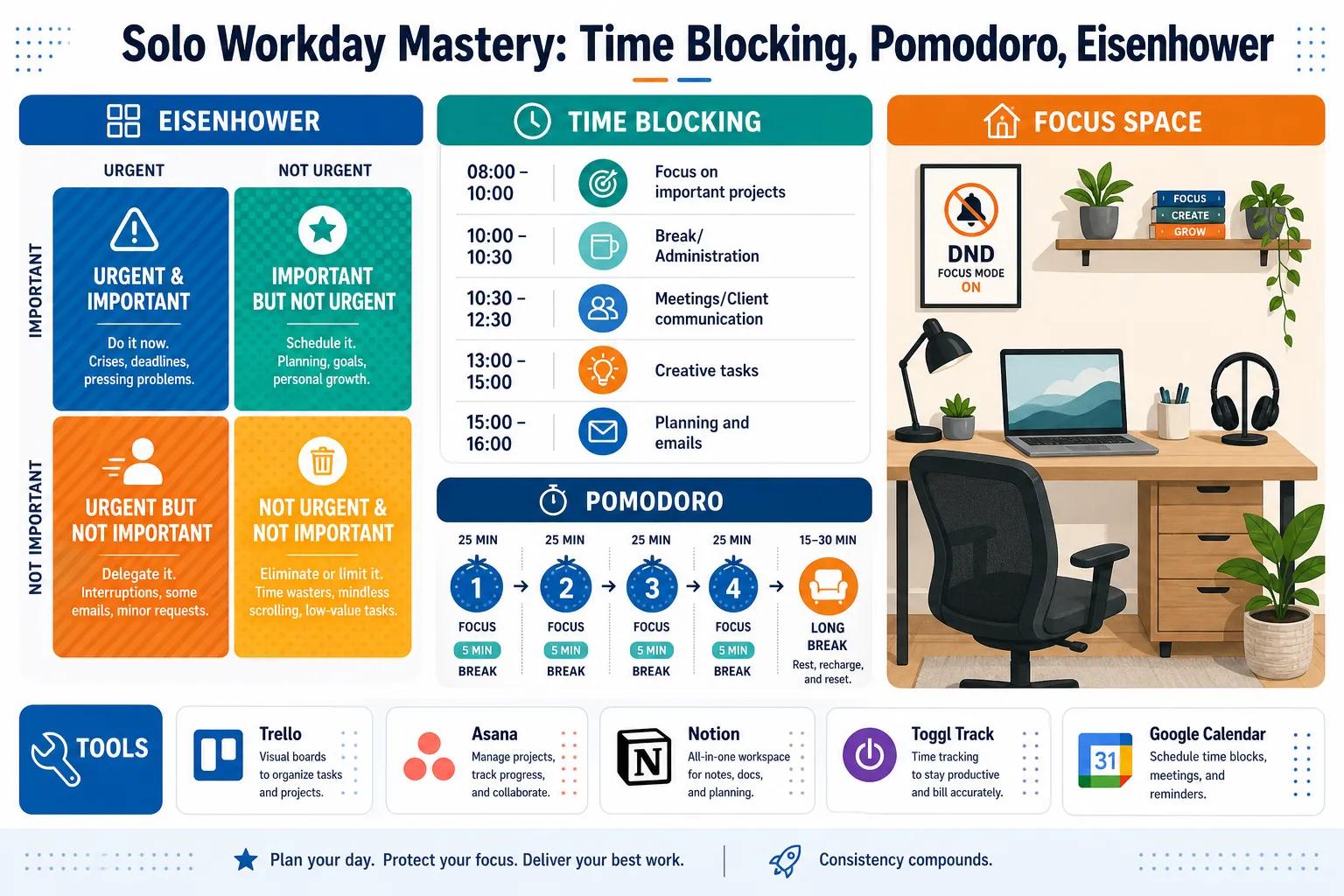
Time Blocking method
Time blocking is one of the most effective work organization methods. The idea is simple — you pre-book specific parts of the day for concrete tasks.
Example of an organized day:
- 8:00 – 10:00 → work on important projects
- 10:00 – 10:30 → break and administration
- 10:30 – 12:30 → meetings and communication with clients
- 13:00 – 15:00 → creative tasks
- 15:00 – 16:00 → planning and replying to emails
This method helps you focus on one thing at a time instead of constantly switching between tasks.
Pomodoro technique for better concentration
The Pomodoro method is especially popular among freelancers and remote workers because it helps maintain focus without mental fatigue.
Working principle:
- you work focused for 25 minutes
- you take a 5-minute break
- after four cycles, there is a longer break of 15 to 30 minutes
This way of working reduces procrastination and improves concentration throughout the day.
Advantages of the Pomodoro method:
- easier focus maintenance
- less mental fatigue
- better time organization
- higher motivation to start working
Effective time management techniques: the Eisenhower matrix, Time Blocking, and the Pomodoro technique
This chapter analyzes three proven methods: the Eisenhower matrix for prioritization, time blocking for conscious time planning, and the Pomodoro technique for maintaining focus and concentration.
Maximizing Efficiency: Practical Strategies for Time Management, Goal-Setting, Productivity, and Balance, 2025
The Eisenhower matrix for prioritizing
One of the biggest problems in independent work is the feeling that everything is urgent. The Eisenhower matrix helps distinguish important tasks from unimportant activities.
Tasks are divided into four categories:
- Urgent and important → do immediately
- Important but not urgent → plan
- Urgent but not important → delegate
- Not urgent and not important → eliminate
This method helps you focus on activities that actually deliver results.
How to maintain focus while working from home?
Working from home often brings many distractions — social media, television, household chores, or constant notifications. That is why it is important to create a work environment that encourages concentration.
Set up a dedicated workspace
Even if you do not have a separate office, try to organize a corner that will be used exclusively for work. The brain then more easily associates that space with focus and work.
A good workspace should have:
- a quality chair and desk
- enough light
- minimal distractions
- neatly organized documents and equipment
In a coworking space, productivity often increases further because the work environment encourages discipline and focus.
Turn off distractions during work
One of the biggest enemies of productivity are notifications and multitasking.
How to reduce distractions:
- turn off notifications on your phone
- use apps to block social media
- work in fullscreen mode
- use headphones for better concentration
- set specific times for checking emails
Small changes can significantly increase work efficiency.
Best tools for organizing a freelancer’s work
Digital tools today can greatly simplify project organization, communication, and time tracking.
Trello
Trello is an excellent tool for organizing tasks and projects using visual boards. It is ideal for freelancers who work on multiple projects at the same time.
Asana
Asana enables detailed planning of tasks, deadlines, and team collaboration. It is especially useful for more complex projects.
Notion
Notion combines notes, planning, databases, and project management in one platform.
Toggl
Toggl is a popular time-tracking tool. It helps freelancers see how much time they spend on individual tasks and clients.
Google Calendar
The calendar is still one of the best tools for organizing the working day and scheduling meetings.
How to avoid burnout when working independently?

Many freelancers fall into the trap of constantly working without a clear end to the working day. In the long run, this leads to exhaustion and a drop in productivity.
Signs of burnout:
- chronic fatigue
- lack of motivation
- loss of concentration
- feelings of frustration
- insomnia and stress
That is why it is important to set boundaries between work and private life. You can read more about it here.
Set clear working hours
One of the biggest advantages of independent work is flexibility, but it can also become a problem.
Define:
- your start time
- your end time
- break times
- days when you do not work
When work has a clear structure, it is easier to maintain balance and long-term productivity.
Why are breaks important for productivity?
Many people think they will be more productive if they work without stopping, but research shows the opposite. Short breaks improve concentration, creativity, and decision-making.
Good habits include:
- a short walk
- stretching
- hydration
- a break from screens
- a few minutes without your phone
A break is not a waste of time — it increases the quality of work.
How to set goals and track progress?
Without clear goals, it is difficult to measure progress and maintain motivation.
SMART goal-setting method
Goals should be:
- Specific
- Measurable
- Achievable
- Relevant
- Time-bound
Example of a bad goal: “I want to be more productive.”
Example of a good goal: “I want to complete three client projects by Friday and reduce the time spent on social media by 50%.”
Daily and weekly to-do lists
Planning tasks in advance reduces stress and increases focus.
Best practices:
- plan the next day in the evening
- identify 3 most important tasks
- use priorities
- track progress during the week
Small, consistent habits bring the greatest results in the long run.
How can a coworking space help productivity?
Many freelancers notice a significant increase in productivity when working from a coworking space instead of from home.
Benefits of coworking spaces:
- professional work environment
- fewer distractions
- better focus
- networking opportunities
- clear separation between work and private life
- higher motivation to work
Working in a quality coworking space can help create a routine and a more professional organization of the working day. An example of such a coworking space is Cowork Zagreb, which provides freelancers, entrepreneurs, and remote professionals with a modern and productive work environment tailored to everyday business needs.
Conclusion
Organizing the working day is key to successful independent work. Without good structure, it is easy to experience a drop in productivity, stress, and burnout. By using methods such as time blocking, the Pomodoro technique, and the Eisenhower matrix, it is possible to significantly improve focus and efficiency.
Equally important are a quality work environment, proper breaks, and clearly defined boundaries between work and private life. With the right tools, good organization, and discipline, freelancers and remote professionals can work more productively, healthily, and with less stress.
If you are looking for a space that encourages focus, productivity, and professional development, a coworking environment can be an excellent step toward better work organization and a higher-quality professional life.