


Working from Home vs Coworking in Zagreb: Stay Focused & Avoid Burnout
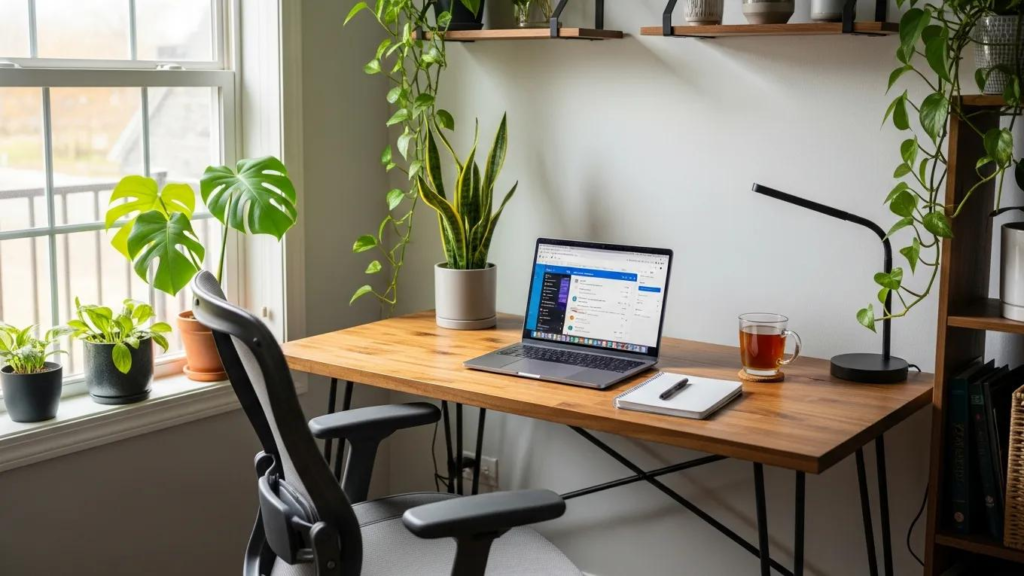
Working from home has become the standard in recent years for freelancers, entrepreneurs, and remote employees. At first glance, it seems like an ideal scenario: flexible working hours, the comfort of your own home, and complete control over your environment.
But the reality is often different.
If you work from an apartment in Zagreb — especially without a separate workspace — the boundary between private and professional life quickly disappears. The kitchen table becomes an office, breaks turn into distractions, and maintaining focus becomes increasingly difficult.
In this article, we explore:
- the most common mental challenges of working from home
- practical strategies for improving focus and productivity
- why coworking in Zagreb is becoming an increasingly popular solution
The most common mental challenges of working from home
Working from home is not just a logistical issue — it is also a psychological one. Research in the field of organizational psychology shows that the work environment has a direct impact on levels of focus, motivation, and overall work performance.
According to research by Harvard Business Review, employees who work in a clearly defined workspace achieve significantly better results than those working in an informal, unstructured environment.
Working from home offers freedom, but also a range of hidden challenges that directly affect productivity and mental health.
1. Isolation and lack of social interaction
Without colleagues and a work environment, many people experience a drop in motivation. The lack of spontaneous conversations and exchange of ideas can, over time, lead to a feeling of stagnation.
2. Constant distractions
At home, there is always something that pulls your attention away:
- household chores
- social media
- household members or noise
- TV or mobile phone
Unlike in an office, there is no clear “work mode.”
3. Lack of structure
Without a defined start and end to the workday, work tends to stretch out. This often leads to:
- working overtime
- feeling guilty when you’re not working
- a drop in productivity
4. Difficulty separating work and private life
Working from the same space in which you live creates
Why working from home reduces focus (and what’s actually happening)
Productivity is not just a matter of discipline — it’s also a matter of environment.
When you work from home:
- the brain does not associate the space exclusively with work
- you are constantly exposed to “micro-distractions”
- there is no external pressure or structure
This leads to what is known as fragmented focus — the constant shifting of attention between tasks.
The result?
- slower work
- more mistakes
- mental fatigue
How to organize your workspace for maximum focus
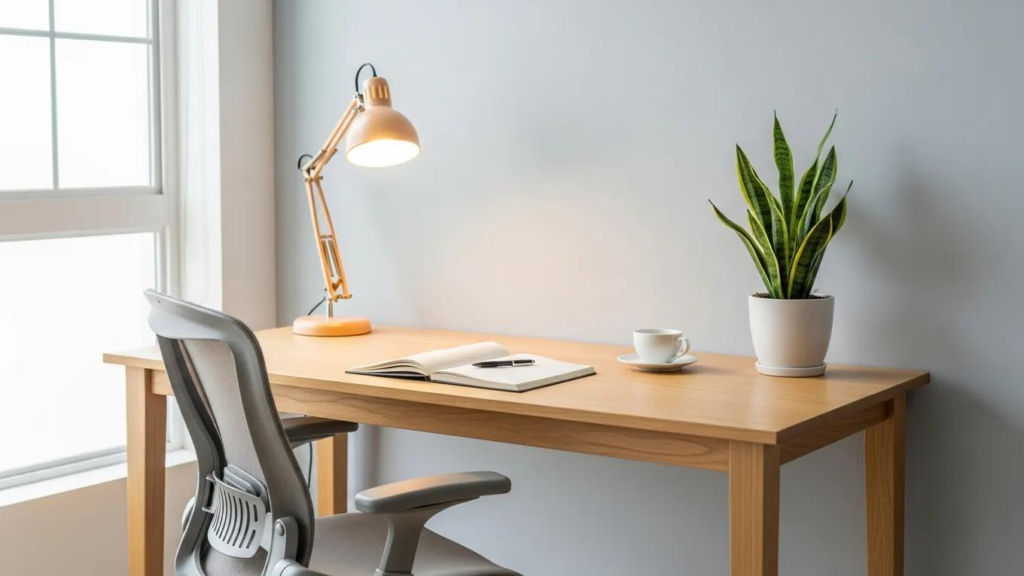
One of the fastest ways to improve productivity is to optimize your work environment.
Key elements of an effective workspace
| Element | What to do | Result |
|---|---|---|
| Workspace | Set aside a corner or desk only for work | Clear mental boundary |
| Ergonomics | Proper chair and screen height | Less physical fatigue |
| Lighting | Natural light or a good lamp | Better concentration |
| Minimalism | Remove unnecessary items | Fewer distractions |
Additional tips:
- use headphones to block out noise
- avoid working from bed or the couch
- keep your workspace tidy
Still, even with a perfectly organized home office — distractions never completely disappear.
Time management techniques that actually work
If you want to maintain focus, structure is key
Pomodoro technique
Work for 25 minutes → 5-minute break
After 4 cycles → a longer break
Why it works:
- reduces mental fatigue
- increases sense of progress
Time blocking
You pre-define time blocks for:
- deep work
- meetings
- breaks
Rule of 3 tasks
Each day define:
- 3 key tasks you must complete
This prevents feelings of overwhelm.
Planning the day in advance
Best done in the evening:
- write a to-do list
- define priorities
How to set boundaries between work and private life

Without clear boundaries, working from home quickly becomes a source of stress.
Practical strategies:
- define working hours (e.g. 9–17)
- physically leave your workspace after work
- do not respond to work messages outside working hours
- communicate your schedule with household members
Research shows that people who clearly separate work and private life have:
- less stress
- higher productivity
- a better sense of control
Why coworking in Zagreb is becoming increasingly popular
More and more people are realizing that working from home is not sustainable in the long term — at least not every day.
That’s why coworking in Zagreb is becoming a logical choice.
What does coworking offer that home cannot?
1. Professional environment
When you enter a coworking space: → you automatically switch into “work mode”
2. Fewer distractions
There are no:
- household chores
- television
- constant interruptions
3. Social interaction
Working among people:
- increases motivation
- reduces feelings of isolation
- encourages idea sharing
4. Flexibility
You can choose:
- hot desk
- private office
- working a few days per week
How Cowork Zagreb solves the key problems of working from home
If you’re looking for a concrete solution in Zagreb, Cowork Zagreb offers a balance between flexibility and structure.
Key advantages:
Flexible work models
- daily rentals
- monthly memberships
- private offices
Focused environment
The space is designed for productivity:
- ergonomics
- quiet atmosphere
- stable internet
Community and networking
Working in a coworking space is not just about work:
- you meet other freelancers
- you create business opportunities
- you gain community support
Mental reset
Even 2–3 days per week outside the home can:
- increase focus
- reduce stress
- improve work-life balance
Boundary management between work and private life among remote workers
This thematic paper examines whether managing boundaries between work and private life has a positive effect on work–life balance in the context of remote work. The results are inconsistent. In the long term, they indicate that successful management of these boundaries has a positive effect on work–life balance, while the absence of such management has a negative impact on this balance.
Does boundary management between work and private life improve work–life balance among remote workers: a critical review of the topic, 2023.
Most common mistake: working exclusively from home
Many people think the optimal solution is: → 100% remote from home
In practice, the best results come from a combination:
- working from home (flexibility)
- coworking (focus and structure)
This hybrid approach enables:
- higher productivity
- better mental balance
- long-term sustainability of work
How do you know you need a coworking space?
Many people ignore the signs that working from home is no longer working for them for too long. The problem is that the decline in productivity does not happen suddenly — but gradually, through a loss of focus, motivation, and clear work structure.
If you recognize yourself in the following situations, it is very likely that a change of work environment, such as a coworking space, could significantly help you:
- you struggle to concentrate and often interrupt work due to minor distractions
- you constantly postpone tasks and catch yourself doing unimportant things
- you work more hours than before, but feel like you are achieving less
- you feel mental fatigue and a drop in motivation already by mid-day
- you lack interaction with other people and a professional environment
- you find it difficult to separate work from private life and feel like you are “always at work”
These signs are not rare — in fact, they are very common among people who work from home long-term without clear structure. The problem is not a lack of discipline, but an environment that is not optimized for focus and productivity.
That is precisely why a change of space can have a big impact. Even a few days per week in a coworking environment can help you re-establish routine, increase concentration, and regain a sense of control over your workday.
If you recognize yourself in most of these points, it is a clear signal that it is time for a change — and that a coworking space could be a simple but very effective solution.
Conclusion: focus is not a matter of discipline — but of environment
Working from home can be great, but only if you have clear structure and discipline.
Otherwise, it very quickly leads to:
- a drop in productivity
- mental fatigue
- loss of focus
That is why more and more professionals in Zagreb are switching to coworking as a smart alternative.
Cowork Zagreb offers exactly what most people lack when working from home:
- focus
- structure
- community
If you want to work more efficiently, feel better, and finally separate your work from your private life — maybe it is time to replace the kitchen table with a professional workspace.